Friday, November 9, 2012


In Defense of Nate Silver, Election Pollsters, and Statistical Predictions

“Nate Silver analyzes poll data on the influential FiveThiryEight blog at The New York Times. He crunches polls and other data in an electoral statistical model, and he claims that his work is guided by math, not left or right politics. Yet he’s become a whipping boy as election day approaches. His crime? Publishing the results of statistical models that predict President Obama has a 73.6 percent chance of defeating the Republican challenger, Mitt Romney.
“The pollsters tell us what’s happening now,” conservative columnist David Brooks told Politico, trashing Silver. “When they start projecting, they’re getting into silly land.” In the same article, MSNBC’s Joe Scarborough added, “And anybody that thinks that this race is anything but a tossup right now is such an ideologue, they should be kept away from typewriters, computers, laptops, and microphones for the next 10 days – because they’re jokes.”
David Brooks is mistaken and Joe Scarborough is wrong. Because while pollsters can’t project, statistical models can, and do … and they do some predictions very well.
We rely on statistical models for many decisions every single day, including, crucially: weather, medicine, and pretty much any complex system in which there’s an element of uncertainty to the outcome. In fact, these are the same methods by which scientists could tell Hurricane Sandy was about to hit the United States many days in advance.
Dismissing predictive methods is not only incorrect; in the case of electoral politics, it’s politically harmful.
It perpetuates the faux “horse race” coverage that takes election discussions away from substantive issues. Unfortunately, many of these discussions have become a silly, often unfounded, time-wasting exercise in fake punditry about who is 0.1 percent ahead. There may well be reasons to consider Ohio a toss-up state, but “absolute necessity for Romney to win the state if he wants to be president” (as Chris Cillizza argues) is not one of them.”
Why Americans Actually Voted For A Democratic House

Although a small number of ballots remain to be counted, as of this writing, votes for a Democratic candidate for the House of Representatives outweigh votes for Republican candidates. Based on ThinkProgress’ review of all ballots counted so far, 53,952,240 votes were cast for a Democratic candidate for the House and only 53,402,643 were cast for a Republican — meaning that Democratic votes exceed Republican votes by more than half a million.
Let’s Not Make a Deal

http://www.nytimes.com/2012/11/09/opinion/krugman-lets-not-make-a-deal.html?_r=0
“So President Obama has to make a decision, almost immediately, about how to deal with continuing Republican obstruction. How far should he go in accommodating the G.O.P.’s demands?
My answer is, not far at all. Mr. Obama should hang tough, declaring himself willing, if necessary, to hold his ground even at the cost of letting his opponents inflict damage on a still-shaky economy. And this is definitely no time to negotiate a “grand bargain” on the budget that snatches defeat from the jaws of victory.”
Thursday, November 8, 2012
Picket Fence Apocalypse

http://campaignstops.blogs.nytimes.com/2012/11/07/picket-fence-apocalypse/?hp
“No, you cannot have your country back. America is moving forward.
That’s the message voters sent the Republican Party and its Tea Party wing Tuesday night when they re-elected President Obama and strengthened the Democrats’ control of the Senate.
No amount of outside money or voter suppression or fear mongering or lying — and there was a ton of each — was enough to blunt that message.”
Watch this: A heartfelt thanks from President Obama

https://www.youtube.com/watch?v=pBK2rfZt32g&feature=player_embedded
Every single person who helped build this campaign deserves to see this thank you from President Obama.
He wasn't just talking to those of us in the office — he was talking to all of you.
Watch the video, and then pass it along.

Little to Show for Cash Flood by Big Donors

At the private air terminal at Logan Airport in Boston early Wednesday, men in unwrinkled suits sank into plush leather chairs as they waited to board Gulfstream jets, trading consolations over Mitt Romney’s loss the day before.
“All I can say is the American people have spoken,” said Kenneth Langone, the founder of Home Depot and one of Mr. Romney’s top fund-raisers, briskly plucking off his hat and settling into a couch.
The biggest single donor in political history, the casino billionaire Sheldon Adelson, mingled with other Romney backers at a postelection breakfast, fresh off a large gamble gone bad. Of the eight candidates he supported with tens of millions of dollars in contributions to “super PACs,” none were victorious on Tuesday.
12 Failed Dick Morris Predictions

http://mediamatters.org/blog/2012/11/07/12-failed-dick-morris-predictions/191212
“During this election cycle, Fox News political analyst Dick Morris repeatedly made outlandish and bizarre electoral predictions at odds with polling data and common sense. His predictions were "so far out on the limb" that Bill O'Reilly told him if Barack Obama wins the election, Morris would be "through." Morris' long track record of terrible prognostication shows that his many strikeouts this cycle aren't an aberration but a steady flow of failure.”
Paul Krugman: Obama Reelection A Victory For The 'Real America'

http://www.huffingtonpost.com/2012/11/07/paul-krugman-obama-victory_n_2089017.html
“Paul Krugman would like to welcome you to the “Real America.”
The New York Times columnist and Nobel Prize-winning economist wrote in an early Tuesday morning blog post that President Obama’s victory is a sign of a changing America that is no longer dominated by “non-urban white people.” (Only 39 percent of the white vote went to Obama this election, according to CNN.com.)
“[T]he real America trumped the 'real America,'” Krugman wrote. “The 2008 Obama coalition wasn’t a fluke; it was the country we are becoming."
Obama’s victory Tuesday night was the result of a diverse coalition of voters. The president scored near-record levels of support from Latino voters and high African-American voter turnout in Virginia -- an important swing state -- were key to Obama’s victory, according to the Wall Street Journal.
In addition, the majority of women voters chose Obama, creating a gender gap that was larger than during the 2008 election.
Krugman is not the only one to call attention to this point. The Huffington Post’s Howard Fineman notes Obama’s “victory signaled the irreversible triumph of a new, 21st-century America: multiracial, multi-ethnic, global in outlook and moving beyond centuries of racial, sexual, marital and religious tradition.”
And some of Obama’s critics even took note of the trend. Senator Lindsey Graham (R-SC) told CNBC in August that there weren’t enough “angry white guys” out there to ensure a Republican victory.”
Transcript: Obama’s Victory Speech

http://blogs.wsj.com/washwire/2012/11/07/transcript-obamas-victory-speech/
“Thank you so much.
Tonight, more than 200 years after a former colony won the right to determine its own destiny, the task of perfecting our union moves forward.
It moves forward because of you. It moves forward because you reaffirmed the spirit that has triumphed over war and depression, the spirit that has lifted this country from the depths of despair to the great heights of hope, the belief that while each of us will pursue our own individual dreams, we are an American family and we rise or fall together as one nation and as one people.
Tonight, in this election, you, the American people, reminded us that while our road has been hard, while our journey has been long, we have picked ourselves up, we have fought our way back, and we know in our hearts that for the United States of America the best is yet to come.
I want to thank every American who participated in this election, whether you voted for the very first time or waited in line for a very long time. By the way, we have to fix that. Whether you pounded the pavement or picked up the phone, whether you held an Obama sign or a Romney sign, you made your voice heard and you made a difference.”
Elizabeth Warren's Big Win Is A Crushing Defeat For Big Banks

“One of Wall Street‘s worst nightmares came true last night. No, not Barack Obama‘s victory over Mitt Romney but Elizabeth Warren‘s Senate victory in Massachusetts.”

Sunday, November 4, 2012
Nonpartisan Tax Report Withdrawn After G.O.P. Protest

“WASHINGTON — The Congressional Research Service has withdrawn an economic report that found no correlation between top tax rates and economic growth, a central tenet of conservative economic theory, after Senate Republicans raised concerns about the paper’s findings and wording.”
And If the GOP Doesn't Win, What Then?

http://www.theatlantic.com/politics/archive/2012/11/and-if-the-gop-doesnt-win-what-then/264495/
“But let's do a thought experiment and assume that current probabilities hold. That would mean that Barack Obama is re-elected; the Romney-Ryan ticket is defeated; and even as the Republicans begin assessing their promising next tier of Christie-Rubio-Jindal-maybe Ryan-maybe Jeb-Bush candidates for 2016, they confront two discouraging realities. One is not having been able to beat a marginally popular president during a time of widespread economic distress. The other is seeing several big demographic blocs -- Latinos, blacks, women -- moving away from them.”
Ohio's Provisional Ballot Order: The Biggest Legal Story of the Weekend

“This dispute is important for many reasons. First, it's probably the most direct evidence yet that Ohio will be counting its provisional ballots for days or even weeks past Tuesday. The blossoming argument above assumes as it must that there will be a great deal of anxious vote counting after Election Day. This scenario hasn't exactly been a secret. But here's an actual live dispute for us all to watch. It's also a reminder that anyone rooting for a resolution Tuesday night (or early Wednesday) ought to hope that it doesn't all come down to Ohio. If it does, it will be weeks -- and one judicial hearing after another -- before we have an answer.
The motion also is important for what it says these days about Husted and the way he is running the state's elections. Leaving aside the provisional ballot court fight for a moment, Saturday's early voting period was hectic, largely because Husted and his fellow Republicans succeeded this cycle in reducing the number of early-voting weekends from five to one. Indeed, they tried to eliminate all such early voting, which traditionally helps wage earners who can't vote during regular business hours on weekdays, but were rejected in this effort by the federal courts.
What does it mean on the ground and to the exercise of a registered voter's right to vote? From The Washington Post late Saturday: "In Cuyahoga, 36,578 had voted as of Friday; in 2008, that number was 54,340. In 2008, there were nine additional early voting days here, and 9,933 people voted on those days." And Husted? While I was searching for the above copy I found another Associated Press story, also dated Saturday, which noted: "Husted says in a statement that voting has gone smoothly in Ohio and he expects absentee voting this year to surpass 2008."
Tribute: Sen. George McGovern on the Presidency From Lincoln to Obama

http://www.readability.com/articles/mwllfjdv
Great interview with the late Senator George McGovern – originally published on TruthDig site in 2009 – I have converted to readability link to make it easy on the eyes:
McGovern: You keep asking me tough questions.
Scheer: No, no, I think that’s probably a good moment on which to end. I just want to say something. As a journalist, and I’m sure [some of] the others in this room are journalists, I’ve interviewed a lot of people in my life. I’ve been around a lot of people who are influential, political, and so forth. I’ve never met a finer human being than George McGovern.
Democracy Danger Signs: Mitt Romney's 800+ Vetoes as Mass. Governor

http://www.alternet.org/election-2012/democracy-danger-signs-mitt-romneys-800-vetoes-mass-governor
From the site:
Mitt Romney's “closing argument” redefines chutzpah. “You know that if the President is re-elected, he will still be unable to work with the people in Congress,” Romney said on Friday. He warned of a government shut-down, or another debt-ceiling crisis – two examples of Congressional Republicans taking the economy hostage for partisan gain – if Barack Obama emerges victorious next week. If elected, Romney promised not to “pass partisan legislation.”
It's a dubious assertion. Romney has made one claim on the campaign trail that is undeniably true. He did bring bipartisanship to Massachusetts – by the time he left the governor's mansion in 2006, many Republicans in the Bay State, like their Democratic counterparts, couldn't stand him.
Romney's Taxes: It's The Carried Interest, Stupid

http://www.forbes.com/sites/janetnovack/2012/08/24/romneys-taxes-its-the-carried-interest-stupid/
Good article containing detailed explanation of carried interest – and this is the guy who’s going to close loopholes?!?
“While Democrats continue to fulminate about Mitt Romney’s failure to release more than two years of his income tax returns, some tax geeks have been itching to get a look at a different set of Mitt and Ann Romney’s private papers—their gift tax returns. That curiosity was stoked in January after the Romney campaign confirmed to Reuters tax columnist David Cay Johnston that Mitt and Ann Romney had paid no gift tax on the transfers made to the Ann & Mitt Romney 1995 Family Trust, worth about $100 million. (The $100 million isn’t included in the financial disclosure forms Romney files as a candidate, since legally the trust assets belong to his heirs. But since it’s set up as a “grantor” trust, Mitt and Ann pay income tax on the earnings within the trust, effectively transferring even more wealth to their offspring.)”
The Great Regression – NYT Graphic
This graphic appeared in the New York Times in September, 2011. It’s well worth reposting here:

The National Debt and Our Children: How Dumb Does Washington Think We Are?

http://www.huffingtonpost.com/dean-baker/national-debt_b_1968868.html
“The fixation on the debt certainly cannot be justified by any objective standard. Clearly the most pressing economic problem facing the country is the tens of millions of people who are unemployed or underemployed as result of the collapse of the housing bubble. These people and their families are seeing their lives ruined due to a monumental failure by policymakers.
Furthermore, it is easy to show that the large budget deficits of recent years are entirely the result of the economic collapse. If the economy were back near full employment, the deficits would be relatively small as was the case before the collapse. Yet it is the deficits and debt that dominate news reporting and debate questions, not the overall state of the economy.”
Saturday, November 3, 2012
Former Regulator Bair Recounts Behind the Scenes of Financial Crisis, Bailouts

http://www.pbs.org/newshour/bb/politics/july-dec12/bair_10-19.html
Transcript of Judy Woodruff’s interview with former head of the FDIC Sheila Bair:
JUDY WOODRUFF: Sheila Bair, welcome.
SHEILA BAIR, former chair, Federal Deposit Insurance Corporation: Thank you for having me. Nice to be here.
JUDY WOODRUFF: So let's just -- just to get some background out of the way, who and what do you think is responsible for the financial collapse of 2008?
SHEILA BAIR: Oh, there's plenty of blame to go around.
I think at the end of the day, it was greed. It was just greed that was unchecked by government and government regulators. This idea that this is all caused because the government wanted poor people to have mortgages, that's just not true.
I think expanding access to homeownership for low-income people was a rationalization, but it was not a driver. A lot of people were making a lot of money, making a lot of irresponsible loans to frankly the vulnerable parts of our population that didn't understand these mortgages to begin with, and regulators didn't step in to stop it.
JUDY WOODRUFF: And, broadly, what is it that you believe the Bush and the Obama administrations did right and did wrong to deal with it?
SHEILA BAIR: Right. Well, I think the missteps going up to the crisis really were both the Clinton and Bush administrations.
I think that the three big ones are we didn't raise bank capital requirements. We didn't constrain the ability of large financial institutions to use leverage, to use borrowed money to support their risk-taking.
Instead, government took a lot of actions to allow investment banks in particular to take on even more leverage and fund their operations with borrowed money, instead of their own equity capital.
The Federal Reserve Board had the authority to set mortgage loaning standards across the board for everyone, banks, non-banks, mortgage brokers. They didn't do that.
And then, finally, of course -- and this was in the Clinton administration -- Congress just said that nobody is going to regulate derivatives. The SEC couldn't regulate them. The CFTC couldn't -- over op-exchange derivatives.
The SEC, the CFTC, even state insurance regulators were told hands off op-exchange derivatives market, so we don't think they need be to regulated.
JUDY WOODRUFF: So, are you saying government had its own share of responsibility for what happened.
SHEILA BAIR: They did.
Yes, but I would say this is because industry lobbying to stop these kinds of steps from being taken.
JUDY WOODRUFF: And what about in response to the crisis once it happened? What was done right and what was wrong?
SHEILA BAIR: Well, right.
Well, I think, as I have said before, I really question -- the Bear Stearns bailout was done in March of 2008. We were not in a crisis situation. We were in a deteriorating situation. I never have seen a good analysis to justify that.
But I do think when the government stepped in to bail out Bear Stearns and support its acquisition by J.P. Morgan Chase -- and Chase was requested to do that -- that that set up an expectation that the government wasn't going to let these other institutions fail.
And so that sent a signal to Lehman Brothers that was having a lot of problems that they were probably going to get a bailout too. And they were a lot bigger than Bear Stearns. So they decided, well, they didn't really take steps to correct themselves.
And because the market had an expectation that there were going to be bailouts, people didn't take steps on their own to fix their problems.
JUDY WOODRUFF: And you're very critical in the book of the whole bailout process...
SHEILA BAIR: Right. I am, yes.
JUDY WOODRUFF: ... and said these banks should have been let go.
As you know, the government, the administration pushes back, saying, if we had let these institutions go, the problem would have been much worse, and what we have done has at least stanched the bleeding. We are now back, we are growing, it's slow, but we're growing.
SHEILA BAIR: Right. Right.
Well, I would agree, at the end of 2008, we were in a situation that was spinning out of control. And we needed to do something, so we threw a lot of money at it.
But the major institutions that were insolvent, they were having what we call liquidity problems, so they were having a hard time because everybody was just so fearful. They were having a hard time borrowing money to contingent-fund their operations.
But they had equity capital. They were not insolvent. Citigroup was insolvent. Merrill Lynch was insolvent. AIG was clearly insolvent. But the rest of the institution I think could have bumbled through it. They might have needed some liquidity support, but they had enough capital to absorb their losses.
But in 2008, we were dealing with a lot of unknowns. And so we threw a lot of money at it. And I guess I can live with that more.
But in 2009, we had a stable system at that point, and that was really the time when we needed to start imposing some pain and accountability.
Very sick institutions like Citigroup should have been fundamentally restructured and broken up. But we didn't even -- we couldn't even get conversations going about that.
JUDY WOODRUFF: Do you feel you did enough to speak up internally against all this?
SHEILA BAIR: Yes. When Congress did authorize all this TARP money, it was my clear understanding -- and one of the reasons I participated in these bailouts -- was that we were going to get a big loan modification program, wide scale, to prevent unnecessary foreclosures from occurring.
And it never happened. Didn't happen under Bush. Didn't happen under Obama. So I do -- that does still make me angry. And, no, I spoke out about it a lot. I was being criticized for speaking out about it a lot.
On the bailouts, maybe I should have done more. We were asked to guarantee all the debt of all the financial institutions. And we said, no, we weren't going to do that. There is a -- I was -- I recall an anecdote where I felt like I was ambushed in a meeting in Hank Paulson's office. He and Ben were there. Tim Geithner was on the phone.
They hand me a script that says the FDIC is going to stand behind all liabilities in the financial system. And I wasn't going do that.
So, we dialed that back. They wouldn't even -- there is an anecdote in my book where we were at least trying to say, let's ban bonuses. If we take any losses on these bailout initiatives, then executive bonuses should be banned.
And the other regulators wouldn't even support us on that. So, yes, I did push. I didn't get much help or support. I was kind of surrounded. We were there by ourselves. Maybe I could have done more. I don't know. How many times can you run into a brick wall at 90 miles an hour? But we did what we did.
JUDY WOODRUFF: Going forward, Sheila Bair, what is it that you see in the prescriptions of either President Obama or Gov. Romney that will fix the problem as you see it today?
SHEILA BAIR: Right. Well, both say they want higher capital requirements. And that's good.
But the problem is, we're hearing people talk good games, but actually getting the rules in place -- we have more capital in the banking system now because the market has demanded it and because we have had this stress-testing process, which is a discretionary process.
But the rules still allow a lot of leverage. We need to get the rules changed. They both say they want to do that, but when you gets specifics, well, how much leverage do you think is appropriate, where would you set the capital requirement, you really don't hear many details.
They both say they want to end too big to fail, thank goodness. Even Alan Greenspan has said, if they are too big to fail, they are too big. Right? So if they can't be -- if they can't fail without hurting the rest of us, then they need to be broken up now.
But, again, Dodd-Frank has provisions to empower regulators to do that now. But will Mr. Obama or Mr. Romney appoint people who are willing to use that authority, who are committed to ending too big to fail?
JUDY WOODRUFF: So, if are you a voter out there trying to make a decision, how do you make a decision then, based on hearing what you just said?
SHEILA BAIR: Well, that's one of the reasons why I wrote the book. I tried to break down some of these issues.
I don't think this gets changed. The financial services industry got too big. They got too big as part of our economy. They got too big in their political influence in Washington. And it is on both sides of the aisle. It is in both political parties.
So unless people educate themselves -- I know people are busy and you have got all sorts of things to learn about and prepare for. But that is one of the reasons I wrote the book, to describe some of these simple concepts and simple steps that need to be taken, and make some accountability with our elected officials to support regulators and appoint regulators who are willing to do it.
JUDY WOODRUFF: Last question. So, are you optimistic this gets fixed or not?
SHEILA BAIR: I am not. I really am not.
We heard -- there was -- thank you to Jim Lehrer. There was a Dodd-Frank question -- I appreciate that -- at the first debate.
The second debate, which was driven by town hall participants, we didn't hear much. And they're not really talking about it on the campaign stump.
And my fear is, they are both worried about alienating all this political money that comes in from the financial sector. So, again, I think people have to educate themselves, speak up, get angry, raise this, or it's not going to get fixed.
JUDY WOODRUFF: Sheila Bair, the book is "Bull By the Horns."
And we're going to ask you to stick around and ask you a few more questions online.
SHEILA BAIR: OK. Great.
JUDY WOODRUFF: So, our viewers can hear more of what you have to say.
Thank you.
SHEILA BAIR: Sounds great. You bet.
Romney’s tongue-tied eloquence

http://fareedzakaria.com/2012/09/27/romneys-tongue-tied-eloquence/
“As President Obama has surged in the polls, Republicans have been quick to identify the problem: Mitt Romney. Peggy Noonan eloquently voiced what many conservatives believe when she said that Romney’s campaign has been a “rolling calamity.” Others have been equally critical of his candidacy. And yet, shouldn’t it puzzle us that Romney is so “incompetent” (also from Noonan), given his deserved reputation for, well, competence? He founded one of this country’s most successful financial firms, turned around the flailing Salt Lake City Olympics and was a successful governor. How did he get so clumsy so fast?
In fact, the problem is not Romney but the new Republican Party. Given the direction in which it has moved and the pressures from its most extreme — yet most powerful — elements, any nominee would face the same challenge: Can you be a serious candidate for the general election while not outraging the Republican base?”
Dewey, Cheatham and Howe for Romney

‘But Konczal points out that there’s a more mundane financial reason Wall Street is mad at Obama: financial reform, even if it’s weaker than we might like (and it is, much), will undermine several highly profitable rackets. More transparent markets for derivatives hurt the profits of firms that were selling things nobody understood; interchange reform hurts the profits of the companies that were earning big monopoly rents on credit cards; consumer protection undermines the business of making money by duping financial customers. All this adds up to a surprisingly large amount of money — and that’s even before we get to things like increased capital requirements for systemically important institutions.’
Friday, November 2, 2012
The billionaires next door

http://blogs.reuters.com/great-debate/2012/10/15/the-billionaires-next-door/
“Even so, the correct etiquette in today’s plutocracy, particularly among its most admired tribe, the technorati of the U.S. West Coast, is to downplay the personal impact of vast wealth. In April 2010, when MIT students asked him how it felt to be the richest person in the world, Bill Gates suggested it wasn’t a very big deal. “Well, the marginal return for extra dollars does drop off,” Gates said. “I haven’t found any burgers at any price that are better than McDonald’s.” He admitted there were some great perks, like flying on a private jet, but said that after a “few million or something, it’s all about how you’re going to give it back.”
The Buffett Rule Explained

http://www.whitehouse.gov/economy/buffett-rule
What's the deal with our current tax system?
Under the current U.S. tax system, a number of millionaires pay a smaller percentage of their income in taxes than a significant proportion of middle class families. Warren Buffett, for example, pays a lower effective tax rate than his secretary, and that’s not fair.
A full 22,000 households that made more than $1 million in 2009 paid less than 15 percent of their income in income taxes — and 1,470 managed to pay no federal income taxes on their million-plus-dollar incomes, according to the IRS.
And, the very wealthiest American households are paying nearly the lowest tax rate in 50 years— some are paying just half of the federal income tax that top income earners paid in 1960. But the average tax rate for middle class families has barely budged. The middle 20 percent of households paid 14 percent of their incomes in 1960, and 16 percent in 2010.
The Obama economy: This time was different, at least at the beginning

“The unquestioned authorities on major financial crises and their lengthy hangovers are Carmen Reinhart and Ken Rogoff, the authors of “This Time is Different,” the key history of the subject. And, in a new paper, they try to set the record straight: “The aftermath of the U.S. financial crisis has been quite typical of post-war systemic financial crises around the globe. If one really wants to focus just on United States systemic financial crises, then the recent recovery looks positively brisk.”
Mitt Romney: The Great Deformer

http://www.thedailybeast.com/newsweek/2012/10/14/david-stockman-mitt-romney-and-the-bain-drain.html
Bain Capital is a product of the Great Deformation. It has garnered fabulous winnings through leveraged speculation in financial markets that have been perverted and deformed by decades of money printing and Wall Street coddling by the Fed. So Bain’s billions of profits were not rewards for capitalist creation; they were mainly windfalls collected from gambling in markets that were rigged to rise.
Thursday, November 1, 2012
Frankenstein Economics is killing capitalism

http://www.marketwatch.com/story/frankenstein-economics-is-killing-capitalism-2012-10-23?siteid=nbch
“Capitalism’s Frankenstein Economics is failing our nation with its core myth of Perpetual Growth, which assumes infinite resources with infinite opportunities for growth, profits, income, and wealth. Ad infinitum.
Though rich and brilliant, American capitalists have a childlike, irrational conviction that they can indefinitely mine, fish, dump, produce, grow and extract resources from the planet’s limited supply, without ever paying a steep price or planning for the day the planet’s resources are exhausted.”
Wednesday, October 31, 2012
Joseph Stiglitz on WNYC ‘Here’s the Thing’

http://www.wnyc.org/shows/heresthething/2012/may/07/
“This week on Here’s the Thing, Alec talks about the financial crisis with Joseph Stiglitz, a Nobel Prize-winning economist. Stiglitz shows no restraint when unleashing criticism of presidential policies -- on both sides. Of President Barack Obama’s financial-industry rescue plan, Stiglitz said that whomever designed it was "either in the pocket of the banks or … incompetent." Stiglitz talks to Alec about growing up in Gary, Indiana and how that impacted his decision to become an economist.”
Tuesday, October 30, 2012
The Nate Silver backlash

http://www.washingtonpost.com/blogs/ezra-klein/wp/2012/10/30/the-nate-silver-backlash/
“It seems to happen every few weeks. The race tightens or widens or simply continues on exactly as it’s been, and some pundit or reporter declares it a staggering humiliation for the burgeoning world of election quants.”
Monday, October 29, 2012
How Did Things Get So Screwed Up?

http://jaredbernsteinblog.com/how-did-things-get-so-screwed-up/
Thoughtful column from Jared Bernstein’s blog:
But again, what bothers me about the Romney campaign and the current moment is not just the policy agenda. It’s their ability to completely deny that agenda and gain ground in the polls. It’s Romney’s ability to very successfully argue that he doesn’t really have a big tax cut (the first debate), that the tax cut he doesn’t really have can be paid for by magic math, that his foreign policy is the same as the President’s (the last debate), that his plan will add 12 million jobs—the number that forecasters tell us we’re likely to see regardless of who wins.
How did we devolve to a country where someone like this can just assert things with virtually no backup from reality and not only be taken seriously but be allegedly gaining ground on a President with a solid, if not inspiring, record? A President who can, with building evidence, make the case that were heading out of the economic woods, who’s got a budget that’s been scored by the CBO to stabilize the debt within the next decade, who plans to implement historic health care legislation that will unquestionably help tens of millions of people?
Blaming Obama for George W. Bush’s Policies

http://economix.blogs.nytimes.com/2012/08/14/blaming-obama-for-george-w-bushs-policies/
“Although it was quickly overshadowed by his choice of Representative Paul D. Ryan of Wisconsin as his running mate, Mitt Romney released an important document last week by his principal economic advisers that deserves more attention than it got. It is an audacious attempt to blame Barack Obama for the economic mistakes of George W. Bush and Republicans in Congress.”
What Do the Polls Tell Us?

http://talkingpointsmemo.com/archives/2012/10/what_do_the_polls_tell_us.php?m=1
“With 9 days to go before election day, I thought I’d take a moment to go over where the polls are as of today and what if anything they can tell us about what the headlines will be on November 7th.
If you’re a polling or data diehard a good bit of what follows may seem obvious. But not everyone’s a data nerd. So I want to go through a lot of data points and basic questions we get in one go. So here goes.”
Suddenly Centrist Romney Repeatedly Praises Obama’s Foreign Policy In Debate

http://thinkprogress.org/security/2012/10/23/1071121/romney-obama-foreign-policy-debate/?mobile=nc
“If you didn’t know better, you would think at times in the third and final debate that Governor Mitt Romney was actually an Obama campaign surrogate. For someone who once said, “This is the first time we’ve had a president that doesn’t have a foreign policy,” Romney agreed in part or in totality with an astonishing number of the President’s policies.”
Campaign enters final stretch as Obama takes final debate

http://www.cnn.com/2012/10/22/politics/debate-mainbar/index.html
“President Barack Obama put Republican challenger Mitt Romney on the defensive on foreign policy in the final presidential debate Monday night, with analysts and an immediate poll giving Obama the victory.”
Sparring Over Foreign Policy, Obama Goes on the Offense

Picking up where he left off in last week’s debate, Mr. Obama went on offense from the start, lacerating his challenger for articulating a set of “wrong and reckless” policies that he called incoherent. While less aggressive, Mr. Romney pressed back, accusing the president of failing to assert American interests and values in the world to deal with a “rising tide of chaos.”
Saturday, October 20, 2012
Finally Liberated From Facts, Mitt Romney the Pure Bull Artist Takes Flight

“You know those Balsa wood airplanes – not the glider-types but the deluxe models, powered by rubber bands, with little propellers on the nose? I thought of those planes watching Mitt Romney debate Barack Obama the other night.”
In debate, Romney struggled on substance

“They say that to tell who won a debate, watch it with the sound off. What I learned after the last debate, however, is that to tell what was actually said at a debate, you don’t want to watch it at all. You want to read it.
After the first debate, President Obama’s supporters comforted themselves by saying Obama’s deficiencies were stylistic, and Romney’s victory was the result of confident lying. But reading the transcript, it quickly came clear that President Obama’s stylistic shortcomings were connected to his substantive shortcomings. His answers were rambling, his case for his candidacy was vague, and his attacks on Romney were often confused.
So I sat down tonight with a rush transcript of tonight’s debate. The same thing was true. The candidate who struggled on style also struggled on substance. But this time, that candidate was Romney.”
Footnoting the debate!

http://www.washingtonpost.com/blogs/ezra-klein/wp/2012/10/16/footnoting-the-debate-2/?wpisrc=nl_wonk
“Think of this as real-time context for the various statistics and ideas the two candidates talked about this evening. We let you know where you can find more information and whether there were any red flags for how candidates are using various pieces of evidence.”
For the President, Punch, Punch, Another Punch

“President Obama, who concluded that he was “too polite” in his first debate with Mitt Romney, made sure no one would say that after their second. He interrupted, he scolded, he filibustered, he shook his head.”
The Self-Destruction of the 1 Percent

“In the early 14th century, Venice was one of the richest cities in Europe. At the heart of its economy was the colleganza, a basic form of joint-stock company created to finance a single trade expedition. The brilliance of the colleganza was that it opened the economy to new entrants, allowing risk-taking entrepreneurs to share in the financial upside with the established businessmen who financed their merchant voyages.”
Bill Moyers: Plutocracy Rising
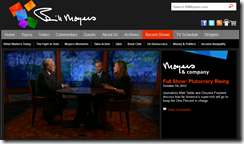
http://billmoyers.com/episode/full-show-plutocracy-rising/
“The One Percent is not only increasing their share of wealth — they’re using it to spread millions among political candidates who serve their interests. Example: Goldman Sachs, which gave more money than any other major American corporation to Barack Obama in 2008, is switching alliances this year; their employees have given $900,000 both to Mitt Romney’s campaign and to the pro-Romney super PAC Restore Our Future. Why? Because, says the Wall Street Journal, the Goldman Sachs gang felt betrayed by President Obama’s modest attempts at financial reform.”
Monday, October 15, 2012
Franklin D. Roosevelt Refutes Romney Ryan Tax Plan
I am often struck by the fact that some things NEVER change – here’s a wonderful example of that:
Romney’s Unraveling Claim That Six Studies Validate His Tax Plan

http://tpmdc.talkingpointsmemo.com/2012/10/romney-challenged-on-six-studies-validating-tax-plan.php
From the site:
“In response to the persistent and substantial questions about the math of his tax plan not adding up, Mitt Romney and his campaign frequently argue that six independent studies back him up by ratifying the arithmetic of the centerpiece of his domestic agenda.
But the talking point about the talking point is unraveling.
More and more mainstream outlets are pointing out that they fail to validate its soundness. And on Sunday Romney senior adviser Ed Gillespie was challenged on Fox News by Chris Wallace, who questioned whether the studies are really nonpartisan.
“Those are very questionable. Some of them are blogs. Some of them are from the AEI [American Enterprise Institute], which is hardly an independent group,” Wallace said. “One of them is from a guy who is — a blog from a guy who was a top adviser to George W. Bush. These are hardly nonpartisan studies.”
“These are very credible sources,” Gillespie said.
Of the six studies, two are blog posts by the conservative American Enterprise Institute; one is a report by the Republican-friendly Heritage Foundation; one is a paper by Princeton professor and former George W. Bush adviser Harvey Rosen; the fifth and sixth are a paper and Wall Street Journal op-ed by Harvard economist Martin Feldstein, an adviser to the Romney campaign.”
Sunday, October 14, 2012
Smilin’ Joe and the Janesville Kid

http://billmoyers.com/2012/10/12/smilin%E2%80%99-joe-and-the-janesville-kid/
“But from a purely strategic point of view, Biden came out ahead by doing what he had to do – reestablishing some credibility for the Barack Obama White House and defibrillating Democrats and progressives who a week ago lay prostrate after the president’s less-than-stellar performance during his first encounter with Mitt Romney.”
Moody’s Chief Economist: Romney’s Tax Plan: ‘The Arithmetic Doesn’t Work’

From the site:
The fact that Mitt Romney’s tax plan is mathematically impossible was reinforced again on Friday, when Mark Zandi, a former John McCain campaign adviser and Chief Economist at Moody’s Economy, admitted as much.
Speaking on CNN’s “Starting Point,” Zandi acknowledged a study by the Tax Policy Center that shows Romney’s plan to lower taxes by 20 percent across the board, while making up those losses in government revenue by closing loopholes on the wealthy, doesn’t add up. Zandi even went so far as to say that “the arithmetic doesn’t work as it is right now”:
ZANDI: Yeah, I think the Tax Policy Center study is the definitive study. They’re non-partisan, they’re very good. They say given the numbers that they’ve been provided by the Romney campaign, no, it will not add up. Now, the Romney campaign could adjust their plan. They could say okay I’m not going to lower tax rates as much as I’m saying right now and they could make the arithmetic work. But under the current plan, with the current numbers, no it doesn’t. I’ll say one other thing, though. I think it is important that we do focus on the so-called tax expenditures in the tax code. Those are the deductions, and credits, and loopholes in the code. We need to reduce those, because if we do we’re going to make the tax system fairer, easier to understand and ultimately lead to stronger growth. So that’s the right place to focus. But, no, the arithmetic doesn’t work as it is right now.
Robert Shrum on the Vice Presidential Debate: Biden’s Win Was a Big F@$&ing Deal

“It’s no contest—Biden nailed it. But Obama still needs to seal the deal. Robert Shrum on the three things that will determine the outcome of the presidential race—and why they all point toward a Democratic victory.”
Saturday, October 13, 2012
Even Forbes loved Joe at the VP Debate!
Wow, even Forbes loved Joe’s debate performance! Great, GREAT job by the VP – congratulations Joe!

http://www.forbes.com/sites/tjwalker/2012/10/11/joe-biden-is-stronger-communicator-in-vp-debate/
“Ryan also seemed nervous due to early and frequent sipping of water. Biden looked like he was having the time of this life and could go another two hours. Biden spent just the right amount of time looking directly into the camera. Ryan seemed less comfortable and energetic. Conservatives will make much over the fact that Biden laughed, smirked and interrupted Ryan. Liberals found that the best part of the evening.”
Wednesday, October 10, 2012
On the Distributional Effects of Base-Broadening Income Tax Reform

http://www.brookings.edu/research/papers/2012/08/01-tax-reform-brown-gale-looney
“This paper examines the tradeoffs among three competing goals that are inherent in a revenue-neutral income tax reform—maintaining tax revenues, ensuring a progressive tax system, and lowering marginal tax rates. As a motivating example, we estimate the degree to which individual income tax expenditures would have to be limited to achieve revenue neutrality under the individual income tax rates and other features advanced in presidential candidate Mitt Romney’s tax plan, and how the required reductions in tax breaks could change the distribution of the tax burden across households. (We do not score Governor Romney’s plan directly, as certain components of his plan are not specified in sufficient detail, nor do we make assumptions regarding what those components might be.)”
Fact-checking financial recessions

http://www.voxeu.org/article/fact-checking-financial-recessions
Paul Krugman made me aware of this excellent article co-authored by Schularick and Taylor:
“The central part played by credit in the deep downturn and weak recovery fits a recurring historical pattern. Financial crises correlate with more painful recessions. This column takes a close look at 14 advanced economies over the past 140 years and shows that larger credit booms during expansions have been systematically associated with more severe and prolonged slumps. In short, credit bites back. Measured against the historical benchmark, the recent US recovery has been far better than could have been expected.”
Subscribe to:
Posts (Atom)