Sunday, October 2, 2011

Top 10 Logical Fallacies in Politics

Sometimes I think ALL politics is nothing but fallacious arguments. This site seems to agree!

http://open.salon.com/blog/emagill/2010/04/09/top_10_logical_fallacies_in_politics

The human brain is wired all wrong. Those not versed in logic are blissfully unaware of how much our brain messes up the most basic of arguments, leading to the mess of random thoughts, non-sequiturs, cognitive dissonance, white lies, misinformation, and syntax errors that we call consciousness. Luckily, there is one place where all of these logical misteps can be exemplified: politics. What follows is a crash course in some of the most prevelant fallacies we all make, as they appear in modern American politics. And though I consider these the "top 10" logical fallacies in politics, they are not in order, for reasons that should become clear rather quickly.

Interesting Rasmussen Poll

http://www.rasmussenreports.com/public_content/politics/mood_of_america/partisan_trends

From the site (note that I would look for corroboration of this -- Rasmussen polls are always skewed towards right wing / conservative viewpoint -- although allegedly an impartial poll):

The number of Republicans and Democrats in the country is just about even. In fact, the gap between the parties is the smallest it has ever been in nearly nine years of monthly tracking.

During the month of September, 33.9% of Americans considered themselves to be Republicans while 33.7% consider themselves Democrats. For both parties, those numbers are up less than a single percentage point from August. As a result, the number of voters not affiliated with either party fell from an all time high of 33.5% in August back to 32.4% in September.

DOJ Inspector General: Yeah, We Were Wrong About Those $16 Muffins

The $16 muffin that wasn't -- oh, well...O'Reilly certainly got a lot of mileage out of it...it doesn't have to be true!

http://tpmmuckraker.talkingpointsmemo.com/2011/09/doj_inspector_general_yeah_we_were_wrong_about_those_16_muffins.php

The $16 muffin myth is officially debunked.

The Justice Department's Inspector General -- the very same entity which cooked up the $16 muffin figure in their audit of DOJ's conference spending -- issued a statement to Bloomberg Businessweek backing out of their original claim.

"Since our report was issued, the Capital Hilton has stated that other food and beverage items, such as coffee, tea, and fruit, were included in the charged amount," the statement said.

That wouldn't do much to quash the $16 muffin figure, which has already spread like so much frosting and even caused Sen. Chuck Grassley (R-IW) to call for someone to be fired (check out some of Grassley's expenses here).

All this doesn't mean that the IG report didn't flag some potential issues. As Bloomberg reports:

Muffins aside, the IG's report points up other instances where the Justice Dept. overpaid for sweet treats. At a 2009 Justice conference in San Francisco, the government was billed $32 per person for a snack of popcorn, Cracker Jack, and candy bars. Department officials didn't jump up to dispute that part of the audit. Says Gina Talamona, a Justice spokeswoman: "We agree that excessive spending of the types identified in the OIG report should not occur."

Saturday, October 1, 2011

The Structural Imbalance of Political Talk Radio

http://www.americanprogress.org/issues/2007/06/talk_radio.html

Despite the dramatic expansion of viewing and listening options for consumers today, traditional radio remains one of the most widely used media formats in America. Arbitron, the national radio ratings company, reports that more than 90 percent of Americans ages 12 or older listen to radio each week, “a higher penetration than television, magazines, newspapers, or the Internet.” Although listening hours have declined slightly in recent years, Americans listened on average to 19 hours of radio per week in 2006.

Among radio formats, the combined news/talk format (which includes news/talk/information and talk/personality) leads all others in terms of the total number of stations per format and trails only country music in terms of national audience share. Through more than 1,700 stations across the nation, the combined news/talk format is estimated to reach more than 50 million listeners each week.

As this report will document in detail, conservative talk radio undeniably dominates the format:

Our analysis in the spring of 2007 of the 257 news/talk stations owned by the top five commercial station owners reveals that 91 percent of the total weekday talk radio programming is conservative, and 9 percent is progressive.
Each weekday, 2,570 hours and 15 minutes of conservative talk are broadcast on these stations compared to 254 hours of progressive talk—10 times as much conservative talk as progressive talk.
A separate analysis of all of the news/talk stations in the top 10 radio markets reveals that 76 percent of the programming in these markets is conservative and 24 percent is progressive, although programming is more balanced in markets such as New York and Chicago.

Black and White and Re(a)d All Over: The Conservative Advantage in Syndicated Op-Ed Columns

http://mediamatters.org/reports/oped/

This project did something that has never been done before: It amassed data on the syndicated columnists published by nearly every daily newspaper in the country. While a few publications, most notably Editor & Publisher, cover the syndicated newspaper industry, no one has attempted to comprehensively assemble this information prior to now. Because the syndicates refuse to reveal to the public exactly where their columnists are published, when Media Matters for America set out to make a systematic assessment of the syndicated columnist landscape, we had no choice but to contact each paper individually and ask which syndicated columnists are published on their op-ed pages.

The results show that in paper after paper, state after state, and region after region, conservative syndicated columnists get more space than their progressive counterparts. As Editor & Publisher paraphrased one syndicate executive noting, "U.S. dailies run more conservative than liberal columns, but some are willing to consider liberal voices."1

Monday, September 26, 2011

Handy Thing This Internet

The internet is great isn't it? I thoroughly enjoy all the fact-checking that's going on these days. One makes a claim and here come all the evidence that proves the assertion wrong. This is the case with a recent Charles Krauthammer column -- he uses several of the tired Repub talking points that have been refuted -- even by Republicans!

Here's the Krauthammer column:

http://www.washingtonpost.com/opinions/return-of-the-real-obama/2011/09/22/gIQAf7dsoK_story.html

He claims that Obama will raise taxes on 50% of small businesses -- well not exactly! Media Matters references a WaPo column from 2010 wherein Bush economist Alan Vaird refutes the claim as follows:

Alan Viard, an economist in the Bush White House who is now at the American Enterprise Institute, agreed that many firms represented in the top tax brackets are hardly small. Economically, that doesn't matter, he said: Obama would still be raising taxes on a significant source of jobs and economic activity.

Politically, however, it's a very different matter to raise taxes on a Wall Street hedge fund than it is to tax your neighborhood dry cleaner. Which is why Republicans continually define pass-through entities of all sizes as small businesses, a position Viard called a "fallacy."

"How can it be that 3 percent of owners are accounting for 50 percent of small business income? Those firms they're owning can't be all that small," Viard said. "And that's true. They're very large." [The Washington Post, 9/17/10]

Then the false claim -- again an old chestnut -- that cutting taxes increases revenue. Again, it's refuted by Greg Mankiw, former member of Bush Council of Economic Advisers:

I used the phrase "charlatans and cranks" in the first edition of my principles textbook to describe some of the economic advisers to Ronald Reagan, who told him that broad-based income tax cuts would have such large supply-side effects that the tax cuts would raise tax revenue. I did not find such a claim credible, based on the available evidence. I never have, and I still don't.

Math or Class Warfare?

Timely column from Alice Rivkin / Brookings Institute:

http://www.brookings.edu/opinions/2011/0922_class_warfare_rivlin.aspx

"In defending his proposal to ensure that millionaires not pay taxes at lower rates than ordinary wage earners—the Buffett rule—the president said, “It is not class warfare. It is math.” I was reminded of the experience I have had many times when I have talked about the fact that the distribution of income in the United States has become dramatically less equal in recent years, especially at the very top. Average incomes have stagnated while incomes of the very well-healed have sky rocketed. Often someone in the group shouts, “class warfare” or “populism,” meaning “don’t go there.” The shouter thinks invoking images of angry peasants with pitchforks and torches advancing on the castle ought to end any conversation about the distribution of income or wealth."

Sunday, September 25, 2011

Why Voters Tune Out Democrats

I believe that most American's political viewpoints align more with the progressive rather than the conservative agenda. But, surprisingly, people continue to vote against their best interests. Pollster Stanley Greenberg analyzes this phenomena and points to some effective strategies for Democrats.

http://www.nytimes.com/2011/07/31/opinion/sunday/tuning-out-the-democrats.html?_r=1&pagewanted=all

Quote from the article:

"In analyzing these polls in the United States, I see clearly that voters feel ever more estranged from government — and that they associate Democrats with government. If Democrats are going to be encumbered by that link, they need to change voters’ feelings about government. They can recite their good plans as a mantra and raise their voices as if they had not been heard, but voters will not listen to them if government is disreputable.

Oddly, many voters prefer the policies of Democrats to the policies of Republicans. They just don’t trust the Democrats to carry out those promises."

Saturday, September 24, 2011

This Cartoon Speaks for Itself

From Bill Day, cartoonist for the Memphis Commercial Appeal:

http://www.commercialappeal.com/photos/2009/mar/12/106259/

Tuesday, September 20, 2011

Lower Taxes on Rich Don't Lead to Job Growth

Ezra Klein presented this graph on the Ed Schulz show this week:


http://www.americanprogress.org/issues/2011/09/tax_fairness.html

From the site:

"Conservatives have no good explanation for why the economy grew so rapidly in the 1990s despite what they describe as growth-crushing tax rates. The top rates were raised from 28 percent to 31 percent in 1990, and then again to 39.6 percent in 1993—a much steeper rate hike than simply allowing the current 35 percent top rate to revert to 39.6 percent, as President Obama has proposed.

What followed the early 1990s rate increases was an unprecedented economic expansion and a balanced budget. With higher tax rates on both ordinary income and capital gains in effect, business investment was stronger in the 1990s than in the period since the 2001-03 tax cuts. Millions of jobs were created and real incomes grew across the income spectrum. About 18.2 million private-sector jobs were created in the six years after the top tax rate was raised to 39.6 percent in 1993, compared to only 4.7 million private-sector jobs created in the corresponding period after the 2001 Bush tax cuts."

Sunday, September 18, 2011

Google Chairman: Economy Needs Stimulus, Not 'Ludicrous' Spending Cuts

Google CEO gets it right on ABC's This Week:

http://abcnews.go.com/Politics/google-chairman-government-strategy-spending-cuts-ludicrous/story?id=14548966


"Google chairman Eric Schmidt today said the current economic strategy of cutting spending during a slow economy is "ludicrous," and pushed for greater government stimulus to generate demand.

The political wrangling between Republicans and Democrats have left business leaders with no certainty on economic policy, and said what is needed to encourage companies to hire more workers are "predictable, long-term plans."

"The economy is, today, stuck behind the power curve. It needs a lot of encouragement," Schmidt told "This Week" anchor Christiane Amanpour. "It needs not just something like the jobs bill, but also significant government stimulation in terms of buying power and investment. Otherwise, we're set up for years of extraordinarily low growth in the economy and no real solution to the jobless problem."

When asked if he saw "any possibility of a climate for more stimulus," Schmidt responded, "that's a political question. But the current strategy is ludicrous."

"You have a situation where the private sector sees essentially no growth in demand," Schmidt said. "The classic solution is to have the government step in and, with short-term initiatives, help stimulate that demand. If they do it right, they'll invest in income and growth-producing things, like highways and bridges and schools, new opportunities for the private sector to go then build businesses."

Fact checking the CNN and Tea Party Express debate in Tampa

"The Republican presidential debate in Tampa, Fla., co-hosted by CNN and the Tea Party Express, was feisty and provocative, with many of the candidates relying once again on bogus “facts” that we have previously identified as faulty or misleading. "

http://www.washingtonpost.com/blogs/fact-checker/post/fact-checking-the-cnn-and-tea-party-express-debate-in-tampa/2011/09/12/gIQAPCkXOK_blog.html?hpid=z2

Saturday, September 17, 2011

Thursday, September 15, 2011

The Second Death of John Maynard Keynes

From Nation columnist Eric Alterman:

http://www.thenation.com/article/163065/second-death-john-maynard-keynes

"Data-wise, the proof has been in the pudding. While austerity is all the rage among politicians on both sides of the Atlantic, the International Monetary Fund has found that deficit cuts of 
1 percent of gross domestic product tend to raise unemployment by 0.3 percentage points. Markets have also tended to react accordingly. The Dow fell by fully 265 points, or 2.2 percent, on the day Obama signed the Boehner deal and twice that amount again—512 points; 4.3 percent—just two days later. Since the showdown began earlier this year, according to economist Simon Johnson, the stock market has lost about 20 percent of its value (roughly $10 trillion). Thus, the consequence of Tea Party anti-Keynesianism has been, in Johnson’s words, “to reduce publicly funded social benefits—including pensions and Medicare—even as its methods dramatically reduce the value of private wealth now and in the future.”

None of this matters to almost anyone associated with the Republican Party these days. As David Brooks reports in the New York Times, “It used to be that there were many themes in the Republican hymnal. Now there is only one: Government is too big, and it needs to be brought under control.” Its biggest beneficiary is Texas Governor Rick Perry, the new Republican frontrunner, who, Brooks notes, “does very well with the alternative-reality right—those who don’t believe in global warming, evolution or that Obama was born in the U.S.”

Perry sticks to the script as if it were Scripture. “The fact is, government doesn’t create jobs,” he said. “Government can only create the environment that allows the private sector to create jobs.” Thing is, reality has Keynesian bias even in Perry’s Texas. During Perry’s decade-plus tenure as governor, public sector jobs have increased at twice the pace of those in the private sector. For the past three years, jobs in Texas’ private sector have actually fallen by 0.6 percent, while in the public sector they have increased by 6.4 percent. The further anti-Keynesian demand is that budget-balancing be done exclusively with spending cuts. All the Republican presidential candidates rejected a hypothetical deal in which ten dollars of service cuts would be matched by a single dollar of new revenues. Perry, like most of them, signed Grover Norquist’s anti-tax pledge (to “oppose and veto any and all efforts to increase taxes”), and his campaign website promises to “take his proven budget-cutting record to Washington.”"

The Price of 9/11

From Columbia University professor Joseph Stiglitz:

"The September 11, 2001, terror attacks by Al Qaeda were meant to harm the United States, and they did, but in ways that Osama bin Laden probably never imagined. President George W. Bush’s response to the attacks compromised America’s basic principles, undermined its economy, and weakened its security."

http://www.project-syndicate.org/commentary/stiglitz142/English

Is Manufacturing Falling Off the Radar?

http://www.nytimes.com/2011/09/11/business/is-manufacturing-falling-off-the-us-radar-screen.html

"As President Obama urges Congress to enact a package of tax cuts and new government spending intended to revive growth and create jobs, one crucial corner of the American economy — manufacturing — has largely fallen off Washington’s radar screen. "

Tuesday, September 13, 2011

How Banks Got Too Big to Fail

From Mother Jones -- great graphic below:

http://motherjones.com/politics/2010/01/bank-merger-history

"The nation's 10 largest financial institutions hold 54 percent of our total financial assets; in 1990, they held 20 percent. In the meantime, the number of banks has dropped from more than 12,500 to about 8,000. Some major mergers and acquisitions over the past 20 years:"

Sunday, September 11, 2011

Romney’s Jobs Plan: Punts Short, Goes Long on Supply-Side Tax Cuts and Fiscal Austerity

Jared Bernstein has an excellent analysis of the Romney jobs plan -- it's generally more of the same ideas that were proven wrong in the 2000-2008 Bush administration. Supply-side economics benefit the wealthy more than the middle class -- how many times are we going to go down this road expecting a different answer!?

"I pored through Mitt Romeny’s jobs plan last night—it’s a comprehensive piece of work, worth a look. Unfortunately, Mr. Romney offers no solutions for our most pressing short-term problem: high unemployment and the weak job growth. And his long term strategy is based on supply-side measures that have long been associated more with budget deficits and upward wealth redistribution than with job creation."

http://jaredbernsteinblog.com/romney%E2%80%99s-jobs-plan-punts-short-goes-long-on-supply-side-tax-cuts-and-fiscal-austerity/?utm_source=feedburner&utm_medium=email&utm_campaign=Feed%3A+JaredBernstein+%28Jared+Bernstein%29

Subprime Mortgage Bonds Getting AAA Rating S&P Denies to U.S. Treasuries

Let's not take the S&P downgrade too seriously -- below link is from Bloomberg News:

"Standard & Poor’s is giving a higher rating to securities backed by subprime home loans, the same type of investments that led to the worst financial crisis since the Great Depression, than it assigns the U.S. government."

http://www.bloomberg.com/news/2011-08-31/subprime-mortgage-bonds-getting-aaa-rating-s-p-denies-to-u-s-treasuries.html

Ye Olde Ponzi Scheme

From the Incidental Economist -- the post does a good job of illustrating the vacuousness of the recent Rick Perry remarks -- just a slogan designed to catch the ear of anti-government right-wingers :

"It’s become popular these days to blog on how Social Security is or is not like a Ponzi scheme. I hope readers understand what’s going on though. This is all about perception and framing. There’s not a lot of meaning to the use “Ponzi scheme” in this context. You can’t actually convey anything useful about Social Security by labeling it thus."

http://theincidentaleconomist.com/wordpress/ye-olde-ponzi-scheme/

Wednesday, September 7, 2011

Public Opinion Snapshot: Public Shows No Love for Tea Party, Bush

http://www.americanprogress.org/issues/2011/08/snapshot082911.html

"It’s no secret that President Barack Obama has taken some serious hits to his popularity that are chiefly due to the poor economic situation. But that doesn’t mean that the public has changed its mind about his predecessor or embraced the ideas of his opponents. Consider this recent evidence.

In the latest AP/Roper/GfK poll, 51 percent still say George W. Bush deserves almost all or a lot of the blame for the country’s current economic problems. That’s followed by 44 percent who blame Republicans in Congress, 36 percent who blame the Democrats in Congress, and just 31 percent who blame President Obama."

Monday, September 5, 2011

State of Working America

The Economic Policy Institute's "State of Working America" web site:

http://www.stateofworkingamerica.org/

The Limping Middle Class

From former Labor Secretary Robert Reich writing in the NYT:

http://www.nytimes.com/2011/09/04/opinion/sunday/jobs-will-follow-a-strengthening-of-the-middle-class.html?_r=2&pagewanted=1

The graphic says it all -- and I do mean all!

http://www.nytimes.com/imagepages/2011/09/04/opinion/04reich-graphic.html?ref=sunday

Excellent Link from Jared Bernstein's Recent Blog Post

Jared linked to this from Citizens for Tax Justice web site -- you should download the PDF from the CTJ site:

Recent data show that the U.S. is taxed far less than almost all other OECD countries. An increase in revenue is the obvious answer to America's budget deficit.

http://www.ctj.org/ctjreports/2011/06/us_one_of_the_least_taxed_developed_countries.php

Saturday, September 3, 2011

CBO: Up to 2.9 Million People Owe Their Jobs to the Recovery Act

http://www.offthechartsblog.org/cbo-up-to-2-9-million-people-owe-their-jobs-to-the-recovery-act/?utm_source=feedburner&utm_medium=email&utm_campaign=Feed%3A+OffTheChartsBlog+%28Off+the+Charts+Blog+|+Center+on+Budget+and+Policy+Priorities%29


Jon Stewart Daily Show August 18 2011 Episode

Great Jon Stewart segment on income inequality -- watch the first 5 minutes:

http://www.thedailyshow.com/full-episodes/thu-august-18-2011-anne-hathaway


Here is a link to the data from the CIA factbook -- note that this is sorted 'worst to best' whereas the Jon Stewart table sorts from 'best to worst.'

https://www.cia.gov/library/publications/the-world-factbook/rankorder/2172rank.html

More about Who Pays Taxes

Fiscal Times weighs in on the fashionable Republican rant about tax rates for the poor:

http://www.thefiscaltimes.com/Articles/2011/08/31/Who-Pays-No-Taxes-and-Why-Theyre-No-Pot-of-Gold.aspx#page1

“It’s wrong to rail on the 46 percent of people who don't pay income tax,” said Paul Caron, a tax professor at the University of Cincinnati College of Law. “A fairer analysis takes into account all taxes paid—and by this measure, everyone has tax skin in the game,” he said.

It will be hard to change or eliminate the social policy-related tax provisions that knock millions of Americans off the federal income tax rolls, said Roberton Williams, a senior fellow at the Tax Policy Center. Not only would it risk alienating key voting blocs, such as senior citizens, but it could have a serious economic impact, he said. “It’s going to hurt the economy more if you raise taxes on the poor than the rich, because the poor spend every penny they’ve got,” Williams said. “If you take a dollar away from them in tax credits, that’s a dollar they don’t spend.”

Not everyone considers these tax breaks untouchable, however. “This proliferation of credits and benefits at the bottom has really gone too far,” said Chris Edwards, a senior fellow at the libertarian Cato Institute. “There are all kinds of pro-market policies the government can do to offset any harm caused to these people if it’s going to withdraw benefits,” he said. Repealing tariffs on goods from China and other countries would lower the cost of clothing and food for low-income Americans to balance the absence of tax credits, he said.

Can you believe the argument advanced by the Koch er, Cato Institute senior fellow? (sarcasm filter on) Yes, let's go out of our way to withdraw benefits from the lower income 50% of American citizens who control a whopping 2.5% of US wealth!! (sarcasm filter off)

Friday, September 2, 2011

Executive Excess 2011: The Massive CEO Rewards for Tax Dodging

http://www.ips-dc.org/reports/executive_excess_2011_the_massive_ceo_rewards_for_tax_dodging/


Rick Perry By the Book

From WaPo columnist Ruth Marcus:

http://www.washingtonpost.com/opinions/rick-perry-by-the-book/2011/08/30/gIQAJJsbqJ_story.html?hpid=z2
"Perry’s 2010 Tea Party-steeped manifesto, “Fed Up!,” makes George Bush look like George McGovern. Perry has said he wasn’t planning to run for president when he wrote the book, and it shows."

The ratio of corporate profits to wages is now higher than at any time since just before the Great Depression

http://www.politifact.com/truth-o-meter/statements/2011/sep/01/robert-reich/robert-reich-says-ratio-corporate-profits-wages-hi/


From the site:

In an Aug. 29, 2011, column, Robert Reich, the former Labor Secretary under President Bill Clinton and a frequent liberal commentator, offered a number of statistics to back up his call for worker protests rather than parades on Labor Day.

"Labor Day is traditionally a time for picnics and parades," Reich’s column began. "But this year is no picnic for American workers, and a protest march would be more appropriate than a parade."

One of the statistics Reich offered was this: "The ratio of corporate profits to wages is now higher than at any time since just before the Great Depression."

A reader asked us to check this out, so we did.

We turned to statistics compiled by the Bureau of Economic Analysis, the federal office that calculates official statistics about the economy. We found numbers for corporate profits as well as for two measures of worker income -- wage and salary disbursements, and total employee compensation received. We then divided corporate profits by both of the income measurements, all the way back to 1929. (Here are the full statistics from 1929 to 2011 as we calculated them.)

For wages, we found that Reich was essentially correct. The ratio in 2010 -- the last full year in the statistics -- was .281, which was higher than any year back to at least 1929, the earliest year in the BEA database. The next highest ratio was in 2006, at .265. (We didn’t find pre-1929 data, so the one part of Reich’s statement that we can’t prove is that the ratio was higher "just before the Great Depression.")

We also looked at total compensation, since the portion of worker compensation delivered outside of wages has grown significantly since 1929. The numbers were slightly different, but the general pattern still held. The ratio in 2010 was .226, which was matched or exceeded in only four years -- 1941, 1942, 1943 and 1950.

To capture the most up-to-date trends, we also looked at the ratios for the last six quarters. For both wages and compensation, the ratio has risen steadily over that year-and-a-half period. For wages, the ratio has climbed from .274 in the first quarter of 2010 to .290 in the second quarter of 2011. For compensation, the ratio has risen from .220 in the first quarter of 2010 to .234 in the second quarter of 2011.

So numerically, there’s little question that Reich is essentially right. (Or, at least for now he is. Economists note that statistics about corporate profits and wages are often revised after the fact.) A more interesting question is what this trendline actually means.

First, we’ll note that the ratio has been remarkably steady over the time we studied. In 2010, corporate income was 168 times what it was in 1929, and wages were 124 times what they were in 1929. But despite the dramatic increases for both measures individually, these two numbers have grown pretty much in tandem. While corporate profits have grown faster, they haven’t grown dramatically faster. Over the eight-decade period, the ratio between corporate profits and wages -- at least prior to 2010 -- almost always hovered between .150 and .235, a pretty narrow range, all things considered.

Within this range, the ratio has regularly zigzagged up and down. The ratio has peaked during World War II, the early 1950s, the mid1960s, the mid1990s and the middle of the first decade of the 21st century.

The 2010 high broke with this history, making the statistic Reich is talking about all the more striking. And as the quarterly data shows, the spike from 2010 has continued into 2011.

This spike has its roots in basic mathematics. The ratio can rise for either of two reasons -- because corporate profits rise, or because wages stagnate. To a greater degree than in past recessions, both of these developments have happened simultaneously in 2010 and 2011. That’s the immediate reason for the ratio’s sudden increase. The ratio was well within historical norms as recently as 2009, the second year of the recession.

Today, "indicators favorable to workers are either absolutely dreadful, like the percentage of the adult population that is employed, or else improving at a not-very-robust rate, like real compensation per hour, while indicators favorable to business owners, such as record profit levels measured in billions of current dollars, are very delightful indeed," said Gary Burtless, an economist at the centrist-to-liberal Brookings Institution.

There are any number of explanations for why businesses are so reluctant to invest their profits today. For instance, Dan Mitchell, an economist at the libertarian Cato Institute, said the pattern of low corporate investment that we’re seeing today has to do with "a climate of economic uncertainty, largely thanks to the threat of more taxes and regulations."

But the explanation that seems to mesh best with our numbers has to do with economic cycles. While the ratio Reich points to is exaggerated today due to an unusually deep recession and an especially sluggish recovery, the general pattern follows that of other recent recessions, said J.D. Foster, an economist with the conservative Heritage Foundation.

Typically, businesses initially lose ground during a recession, while workers suffer somewhat less, in part due to "sticky wages" -- the tendency for worker pay to increase or stagnate rather than fall, even in hard times. This pattern tends to decrease the ratio of corporate profits to wages.

However, when the recovery begins, the reverse becomes true -- businesses tend to gain ground faster than workers do, since soft labor markets prevent workers from reaping the rewards of improved productivity. This pushes the ratio of profits to wages higher. Since the current recovery is particularly weak, the increase in the ratio has been even stronger than normal.

The hopeful news for workers, Foster says, is that once a recovery gathers steam and new capital-labor equilibrium is reached, workers tend to accelerate their gains.

"Once a strong recovery is under way and labor markets return to normal, total labor compensation tends to catch up, as employers bid for employees out of the extra profit margin they accumulated during the recovery," Foster said. "So once we start heading toward full employment, we can expect total labor compensation to rise very rapidly relative to total income."

So where does this leave us? On the numbers, Reich’s claim is essentially correct. And in his analysis, Reich doesn’t over-promise on what the data indicate. Amid evidence that these numbers could turn out to be a temporary spike, he resists the temptation to label it the culmination of a long-term trend. We find Reich’s formulation both factually supportable and appropriately cautious in its interpretation. We give it a rating of True.

25 CEOs Paid More Than Companies Paid in Taxes

http://www.thefiscaltimes.com/Articles/2011/08/31/CEOs-Whose-Pay-Is-Higher-Than-Their-Companys-Taxes.aspx#page1

"One-fourth of the 100 highest-paid CEOs in America took home more in pay than their companies paid in taxes to the federal government, a new report says."


GOP Targets Regulatory Burdens

What about that tired cliche from the GOP about regulatory burdens being lifted to "empower the private sector"....it's a dubious claim...as the WSJ survey says, the "lack of jobs is due mainly to a lack of sales"...here's info on that:

http://www.northcountrypublicradio.org/news/npr/140115604/in-jobs-debate-gop-targets-regulatory-burdens

Yet in a survey last month of 250 economists by the National Association for Business Economics, 4 out of 5 agreed that the current regulatory environment for American businesses was, in fact, good. In a July survey done by the Wall Street Journal in July, two-thirds of economists said the lack of jobs is due mainly to a lack of sales.

Paul Ashworth, the chief U.S. economist for Capital Economics in Toronto, was one of those surveyed.

"The weakness of the recovery, not just in consumption but across the whole economy — across whole areas of spending — is a big problem," he says. "And that's probably the key reason why firms are reluctant to be more aggressive in hiring workers."

Ashworth, who's considered one of the best forecasters of the U.S. economy, says he doubts rolling back regulations would lead to any dramatic turnaround in hiring. But that does not mean House Republicans won't try.

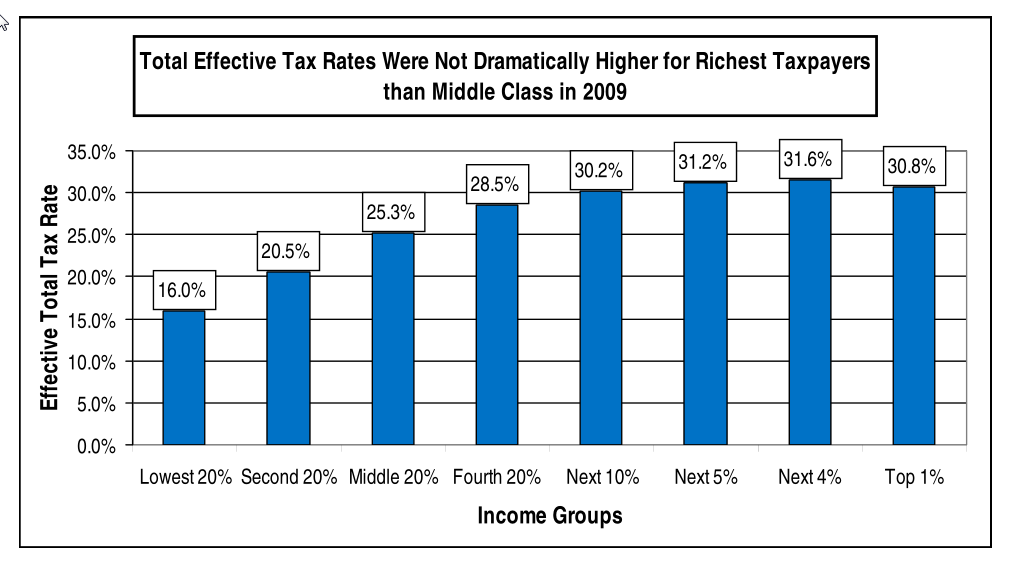
All Americans Pay Taxes


Link to above graph: http://www.ctj.org/pdf/taxday2010.pdf

Also see data here: http://www.responsibletaxes.org/resources/all-americans-pay-taxes/

Are We Nearing Peak Corporate Profits

http://www.ritholtz.com/blog/2011/09/corporate-profits/?utm_source=feedburner&utm_medium=email&utm_campaign=Feed%3A+TheBigPicture+%28The+Big+Picture%29

Peak corporate profits should lead, under normal circumstances, to more hiring and Capex spending. However, we are not seeing enough of either.

Will the corporate version of the Paradox of Thrift become a self-fulfilling prophesy?


Sunday, August 28, 2011

Did the Stimulus Work?

Excellent study by Dylan Matthews...not only of the subject at hand but in general terms it illustrates the strengths and weaknesses of economic analyses...

http://www.washingtonpost.com/blogs/ezra-klein/post/did-the-stimulus-work-a-review-of-the-nine-best-studies-on-the-subject/2011/08/16/gIQAThbibJ_blog.html#conleydupor

Saturday, August 27, 2011

It's the Household Debt Stupid

Excellent post from Ezra Klein: http://www.washingtonpost.com/blogs/ezra-klein/post/its-the-household-debt-stupid/2011/08/12/gIQApqWcZJ_blog.html?wprss=ezra-klein
Ken Rogoff wants to call our economic malaise “the Great Contraction.” Richard Posner wants us to at least call it “a depression.” I tend to dismiss arguments over semantics, but in this case, I agree. If it were up to me, we would call what we’re in a “household-debt crisis,” or something more elegant that gets the same idea across, as that would at least help us think more clearly about what we need to do to get out. If you take the Rogoff/Reinhart thesis seriously -- and people should, and increasingly are -- what distinguishes crises like this one from typical recessions is household debt. When the financial markets collapsed, household debt was nearly 100 percent of GDP. It’s now down to 90 percent. In 1982, which was the last time we had a big recession, the household-debt-to-GDP ratio was about 45 percent. That means that in this crisis, indebted households can’t spend, which means businesses can’t spend, which means that unless government steps into the breach in a massive way or until households work through their debt burden, we can’t recover. In the 1982 recession, households could spend, and so when the Federal Reserve lowered interest rates and made spending attractive, we accelerated out of the recession. The utility of calling this downturn a “household-debt crisis” is it tells you where to put your focus: you either need to make consumers better able to pay their debts, which you can do through conventional stimulus policy like tax cuts and jobs programs, or you need to make their debts smaller so they’re better able to pay them, which you can do by forgiving some of their debt through policies like cramdown or eroding the value of their debt by increasing inflation. I’ve heard various economist make various smart points about why we should prefer one approach or the other, and it also happens to be the case that the two policies support each other and so we don’t actually need to choose between them. All of these solutions, of course, have drawbacks: if you put the government deeper into debt in order to help households now, you increase the risk of a public-debt crisis later. That’s why it’s wise to pair further short-term stimulus with a large amount of long-term deficit reduction. If you force banks to swallow losses or face inflation now, you need to worry about whether they’ll be able to keep lending at a pace that will support recovery over the next few years. But as we’re seeing, not doing enough isn’t a safe strategy, either.

Friday, August 26, 2011

Crashing the Tea Party

http://www.nytimes.com/2011/08/17/opinion/crashing-the-tea-party.html


GIVEN how much sway the Tea Party has among Republicans in Congress and those seeking the Republican presidential nomination, one might think the Tea Party is redefining mainstream American politics.

But in fact the Tea Party is increasingly swimming against the tide of public opinion: among most Americans, even before the furor over the debt limit, its brand was becoming toxic. To embrace the Tea Party carries great political risk for Republicans, but perhaps not for the reason you might think.

Polls show that disapproval of the Tea Party is climbing. In April 2010, a New York Times/CBS News survey found that 18 percent of Americans had an unfavorable opinion of it, 21 percent had a favorable opinion and 46 percent had not heard enough. Now, 14 months later, Tea Party supporters have slipped to 20 percent, while their opponents have more than doubled, to 40 percent.

Of course, politicians of all stripes are not faring well among the public these days. But in data we have recently collected, the Tea Party ranks lower than any of the 23 other groups we asked about — lower than both Republicans and Democrats. It is even less popular than much maligned groups like “atheists” and “Muslims.” Interestingly, one group that approaches it in unpopularity is the Christian Right.

The strange thing is that over the last five years, Americans have moved in an economically conservative direction: they are more likely to favor smaller government, to oppose redistribution of income and to favor private charities over government to aid the poor. While none of these opinions are held by a majority of Americans, the trends would seem to favor the Tea Party. So why are its negatives so high? To find out, we need to examine what kinds of people actually support it.

Beginning in 2006 we interviewed a representative sample of 3,000 Americans as part of our continuing research into national political attitudes, and we returned to interview many of the same people again this summer. As a result, we can look at what people told us, long before there was a Tea Party, to predict who would become a Tea Party supporter five years later. We can also account for multiple influences simultaneously — isolating the impact of one factor while holding others constant.

Our analysis casts doubt on the Tea Party’s “origin story.” Early on, Tea Partiers were often described as nonpartisan political neophytes. Actually, the Tea Party’s supporters today were highly partisan Republicans long before the Tea Party was born, and were more likely than others to have contacted government officials. In fact, past Republican affiliation is the single strongest predictor of Tea Party support today.

What’s more, contrary to some accounts, the Tea Party is not a creature of the Great Recession. Many Americans have suffered in the last four years, but they are no more likely than anyone else to support the Tea Party. And while the public image of the Tea Party focuses on a desire to shrink government, concern over big government is hardly the only or even the most important predictor of Tea Party support among voters.

So what do Tea Partiers have in common? They are overwhelmingly white, but even compared to other white Republicans, they had a low regard for immigrants and blacks long before Barack Obama was president, and they still do.

More important, they were disproportionately social conservatives in 2006 — opposing abortion, for example — and still are today. Next to being a Republican, the strongest predictor of being a Tea Party supporter today was a desire, back in 2006, to see religion play a prominent role in politics. And Tea Partiers continue to hold these views: they seek “deeply religious” elected officials, approve of religious leaders’ engaging in politics and want religion brought into political debates. The Tea Party’s generals may say their overriding concern is a smaller government, but not their rank and file, who are more concerned about putting God in government.

This inclination among the Tea Party faithful to mix religion and politics explains their support for Representative Michele Bachmann of Minnesota and Gov. Rick Perry of Texas. Their appeal to Tea Partiers lies less in what they say about the budget or taxes, and more in their overt use of religious language and imagery, including Mrs. Bachmann’s lengthy prayers at campaign stops and Mr. Perry’s prayer rally in Houston.

Yet it is precisely this infusion of religion into politics that most Americans increasingly oppose. While over the last five years Americans have become slightly more conservative economically, they have swung even further in opposition to mingling religion and politics. It thus makes sense that the Tea Party ranks alongside the Christian Right in unpopularity.

On everything but the size of government, Tea Party supporters are increasingly out of step with most Americans, even many Republicans. Indeed, at the opposite end of the ideological spectrum, today’s Tea Party parallels the anti-Vietnam War movement which rallied behind George S. McGovern in 1972. The McGovernite activists brought energy, but also stridency, to the Democratic Party — repelling moderate voters and damaging the Democratic brand for a generation. By embracing the Tea Party, Republicans risk repeating history.

David E. Campbell, an associate professor of political science at Notre Dame, and Robert D. Putnam, a professor of public policy at Harvard, are the authors of “American Grace: How Religion Divides and Unites Us.”

Thursday, August 25, 2011

Wednesday, August 24, 2011

Interesting Interview with Ken Rogoff and Paul Krugman

From Fareed Zakaria's GPS show on CNN -- air date August 14, 2011:

http://transcripts.cnn.com/TRANSCRIPTS/1108/14/fzgps.01.html

ZAKARIA: Joining me now to talk about Wall Street's wild week, what it means or doesn't mean, and what may lay behind it and what lays - lies ahead of us, two of the world's top economists.

Paul Krugman won the 2008 Nobel Prize in Economics, and he is a columnist for "The New York Times." Kenneth Rogoff is a former chief economist at the International Monetary Fund, now a professor of economics at Harvard University. Welcome to you both.

Paul, let me start with you. The one thing we saw over the week was markets up, markets down, but the one trend that seemed persistent was there is a great demand for U.S. treasuries despite the fact that the S&P downgraded it.

You've been talking a lot about this. Explain in your view what does it mean that in moments like this U.S. treasuries are still in demand and what that does is push interest rates even lower than they are.

PAUL KRUGMAN, COLUMNIST, NEW YORK TIMES: Well, what it tells you is that the investors, the market, are not at all afraid of what the - if you like, the policy elite or people like Standard & Poor's are telling them they should be afraid of.

You know, we - we've got all of Washington, all of Brussels, all of Frankfurt saying debt deficits, this is the big problem. And what we actually have in reality is markets are terrified of prolonged stagnation, maybe another recession. They still see government debt as - U.S. government debt, at any rate - as the safest thing out there, and are saying, if - if this was a reaction of the S&P downgrade, it was the market's saying, you know, we're afraid that that downgrade is going to lead to even more contractionary policy, more austerity, pushing us deeper into the hole.

So it's - it's a - you know, it's a reality test, right? So we just - just had a wake-up call that said, hey, you guys have been worrying about the entirely wrong things. The really scary thing here is the prospect of what amounts to a - a somewhat reduced version of the Great Depression in - in the Western world.

ZAKARIA: Ken Rogoff, worrying about the wrong thing?

KEN ROGOFF, FORMER CHIEF ECONOMIST, INTERNATIONAL MONETARY FUND: Well, I think the downgrade was well justified. It's a very volatile world. And the reason there's still a demand for treasuries is they've been downgraded a little bit to AA plus. That looks pretty good compared to a lot of the other options right now.

It's a very, very difficult time for investors. There is a financial panic going on at some level. Some of it's adjusting to a lower growth expectations, maybe a third of what we're seeing. Two- thirds of it is the idea no one's home - not in Europe, not in the United States. There's no leadership. And I really think that's what's driving the panic.

ZAKARIA: But you wrote in an article of yours that you think that this is part of actually a broader phenomenon which is that people are realizing this is not a classic recession, this is not a classic cyclical downturn. This is what you call a great contraction. Explain what you mean by that.

ROGOFF: Well, recessions we have periodically since World War II, but we haven't really had a financial crisis as we're having now. And Carmen Reinhart and I think of this as a great contraction, the second one, the first being the Great Depression, where it's not just unemployment, it's not just output, but it's also credit, housing and a lot of other things which are contracting. These things last much longer because of the debt overhang that we started with. After a typical recession, you come galloping out. Six months after it ended, you're back to where you started. Another six or 12 months, you're back to trend.

If you look at a contraction, one of these post-financial crisis events, it can take up to four or five years just to get back to where you started. So people are talking about a double dip, a second recession. We never left the first one.

ZAKARIA: So, Paul Krugman, what the implication of what Ken Rogoff is saying is spending large amounts of money on stimulus programs is not going to be the answer because, until the debt overhang works its way off, you're not going to get back to trend growth. So, in that circumstance, you'll be wasting the money. Is that - is -

KRUGMAN: No, that's not at all what it implies. At least not - not - I think my analytical framework, the way I think about this, is not very different from Ken's. At least I certainly believed from day one of this slump that it was going to be something very different from one of your standard V-shaped, you know, down and up recessions, that it was going to last a long time.

One of the things we can do, at least a partial answer, is in fact to have institutions that are able to issue debt - namely the government - do so and sustain spending and, among other things, by maintaining employment, by maintaining income, you make it easier for the private sector to work down that overhang of debt.

ZAKARIA: Ken, are you in favor of a - a second or a significant additional stimulus in the way that I think Paul Krugman is?

ROGOFF: No. I - I think that's where we part ways on this. I mean, I think that creates a - a debt overhang in the terms of future taxes that is not a magic bullet because it's not a typical recession. I do think, if we used our credit to help facilitate one of these plans to bring down the mortgage debt in this targeted way, and it could involve a significant amount, that I would definitely consider. I mean, that's how - that's how I would do it.

Now, obviously, you know, things go from bad to worse, then you start taking out more and more things from the tool kit, but I would start with targeting the mortgages, then higher inflation, try to do some structural reforms and, of course, you know, if things are still going badly, I'm open to more ideas.

ZAKARIA: Paul -

KRUGMAN: Can I just break in?

ZAKARIA: Yes. Yes.

KRUGMAN: I would say things - things have already gone from bad to worse. I mean, this is a terrible, terrible situation out there. You know, we - we talk about it, we look at GDP, whatever. We have nine percent unemployment and, more to the point, we have long-term unemployment at levels not seen since the Great Depression. Just an incredible - incredibly large number of people trapped in basically permanent unemployment.

This is something that desperately needs addressing. And I would be saying we should not be trying one tool after another from the tool kit a little bit at a time. At this point, we really want to be throwing everything we can get mobilized at it.

I - I don't - I don't think fiscal stimulus is - is a magic bullet. I'm not sure that inflation is a magic bullet in the sense that it's kind of hard to get, unless you're doing a bunch of other things. So we - we should be trying all of these things.

And, you know, what - how did the Great Depression end? How did - how did that end? It ended, actually, of course, with World War II, but that - which was a massive fiscal expansion, but also involved a substantial amount of inflation, which eroded the debt. What we need - hopefully we don't need a world war to get there, but we need - we need this kind of all-out effort which we're not going to get (ph) -

ZAKARIA: We're going to have to take a break. When we come back, we'll ask what exactly should the worries about the deficit be? Is - is that something to be taken seriously at all? When we come back.

(END VIDEOTAPE)

(COMMERCIAL BREAK)

(BEGIN VIDEOTAPE)

ZAKARIA: And we are back with Paul Krugman and Paul Rogoff, talking about the economy, the markets and everything else.

Paul Krugman, before we took a break, you talked about the solution to getting us out of this crisis, and you compared it to the '30s and pointed out that World War II got us out of the Depression. This was a massive stimulus, massive fiscal expansion. But aren't we in a different world?

We are, right now, the United States, at 10 percent of budget - budget deficit, 10 percent of GDP, which is the second highest in the industrial world. In two years we'll - our debt-to-GDP ratio goes to 100 percent. That strikes me as a situation which there's got to - presumably there is some upper limit. You can't just keep spending money and incur these larger and larger debt loads.

KRUGMAN: Oh, I don't get us to - I think those numbers are a bit high, about the - about the deficit, a couple - the debt levels a couple years out. It takes longer than that.

But the main thing to say is, look, think about the costs versus benefits right now. Basically, the U.S. government can borrow money and repay in constant dollars less than it borrowed. Are we really saying that there are no projects that the federal government can undertake that have an even slightly positive rate of return? Especially when you bear in mind that many of the workers and resources that you employ on those projects would be otherwise be unemployed.

The world wants to buy U.S. bonds. Let's - let's supply some more, and let's use those bonds to do something useful which might, among other things, help to get us out of this terrible, terrible slump.

ZAKARIA: Ken Rogoff?

ROGOFF: Well, I think you have to be careful about assuming that these low interest rates are going to last indefinitely. They were very low for subprime mortgage borrowers a few years ago. Interest rates can turn like the weather.

But I - I also question how much just untargeted stimulus would really work. Infrastructure spending, if well spent, that's great. I'm all for that. I'd borrow for that, assuming we're not paying Boston Big Dig kind of prices for the infrastructure.

ZAKARIA: But, even if you were, wouldn't John Maynard Keynes say that if you could employ people to dig a ditch and then fill it up again, that's fine. They're being productively employed, they pay taxes, so maybe the big - maybe Boston's Big Dig was - was just fine after all?

KRUGMAN: Think about World War II, right? That was not - that was actually negative for social product spending, and yet it brought us out. I mean, partly because you want to put these things together, if we say, look, we could use some inflation. Ken and I are both saying that, which is of course anathema to a lot of people in - in Washington, but is in fact what the basic logic says.

It's very hard to get inflation in a depressed economy. But if you have a program of government spending plus an expansionary policy by the Fed, you could get that. So if you think about using all of these things together, you could accomplish, you know, a great deal.

I mean, if we - if we discovered that, you know, space aliens were planning to attack and we needed a - a massive buildup to counter the - the space alien threat, and really inflation and budget deficits took secondary place to that, this slump would be over in 18 months. And then if we discovered, oops, we made a mistake there aren't actually any space aliens -

(CROSSTALK)

ROGOFF: So we need Orson Wells is what you're say?

KRUGMAN: No. That's a - that's a - there was a "Twilight Zone" episode like this, which scientists fake an alien threat in order to achieve world peace. Well, this time we don't need it - we need it in order to get some fiscal stimulus.

But, no. I mean, the point is -

ZAKARIA: But Ken - but Ken wouldn't agree with that, right? The space aliens wouldn't work -

ROGOFF: It's not so clear that -

ZAKARIA: Go ahead (ph).

ROGOFF: I think it's not so clear that Keynes was right. I mean, there have been decades and decades of debate about that, about whether digging ditches is such a good idea. And my read of the debate is when the government does really useful things and spends the money in useful ways, it's a good idea. But when it just dig ditches and fills them in, it's not productive and leaves you with debt.

I don't - I don't think that's such a no-brainer. There are people going around saying, oh, Keynes was right. Everything Keynes said was right. I think this is a different animal, with this debt overhang that you need to think about from the standard Keynesian framework.

KRUGMAN: I - I guess I just don't agree. I mean, I think the - the debt overhang - but that was an issue in the '30s, too, private sector debt overhang. We came into this with higher public debt than I would have liked, right? We're really, in some ways, paying the cost to the Bush tax cuts and the Bush unfunded wars, which leave us with a - a higher starting point of debt.

But - but, you know, the - the thing that drives me crazy about this debate, if I can say, is that we have these hypothetical risks. All those hypothetical things are leaving us doing nothing about the actual thing that's happening, which is mass unemployment, mass waste of human resources, mass waste of - of physical resources.

This is - you know, what's happening is we - we are hemorrhaging economic possibilities and also destroying a lot of lives by letting this thing drift on. And we're inventing these - you know, sometimes ghosts are real, I guess, but we're inventing these phantom threats to keep us from - from acting.

ZAKARIA: Do you - do you think that the lesson from history, Ken, in terms of these kind of great contractions - because other countries have had - we - we have not had something like this since the 1930s, but there have been other examples. It tells you that until you get these debt levels down, no matter what the government does, it's not going to get you back to robust growth?

ROGOFF: I do, because what happens as you're growing slowly, the debt problems start blowing up on you. That's happening very dramatically in Europe. They had a - a philosophy and approach of things are going to get much better. this is an ordinary but big recession. If we can just hang on, we're going to grow really fast, the debt problems will go away.

Well, guess what? They're not growing fast enough. The debt problems are - are imploding. That's slowing growth, and it's a self- feeding cycle.

KRUGMAN: I guess I'm - I'm a little puzzled here because, again, the thing that's holding us back right now in the United States, although there are - there are those peripheral European countries that are having a - a very different kind of problem, partly because they don't have their own currencies.

But, in the United States, what's holding us back is private sector debt. And, yes, we - we're not going to have a self sustaining recovery unless that private sector debt could be brought down (ph).

ZAKARIA: Just to be clear, Paul, what you mean by that is individuals have a lot of debt on their - on their balance sheets?

KRUGMAN: Yes. That's what's holding us back, and we do need to bring that down, at least bring it down relative to incomes. So what you need to do is you need to have policies to make incomes grow. You need - and that can include government spending, which is going to add to - to public debt, but it's going to reduce the burden of private debt. It can include inflationary policies, and it can include - and it include deliberate forgiveness.

The idea that - that this has all faded, that we cannot do anything to grow because we have to wait for some natural process to bring that - that debt down, that - that doesn't follow from the analysis. It's - it is the - there is a huge overhang of debt, which is the - at least as I see it, exactly the reason why we need very activist government policies.

ZAKARIA: Ken Rogoff, the last word?

ROGOFF: I do think that the debt of the government, of course it's important. The social security, concerns over future medical spending. A lot of businesses are - and - and people who could invest, could hire people are worried of where the government's going, where taxes are going, what's going to happen to their savings. So I don't think -

KRUGMAN: There's not a hint of that in the data.

ROGOFF: I don't think it's such a - well, not a hint of that? People aren't hiring, and - and there - there's a lot of surveys and -

KRUGMAN: Because they can't sell.

ROGOFF: -- and such showing people (ph).

Yes, but I mean - I mean, interest rates are always low before a crisis. You can't necessarily say that that tells you it's not going to happen.

KRUGMAN: I'm - I guess I'm still in this position of saying that - that things that we have no evidence for, that are supposed to be dangerous, are being - you're blaming it - lots of people are blaming them for something which is - looks to me like straightforward there isn't enough spending in the economy. ROGOFF: We have - we have centuries of examples.

KRUGMAN: Not - I don't read that history the same way.

ZAKARIA: All right. We're going to have to leave it at that.

Paul Krugman, Ken Rogoff we'll have you back very soon to see which way the wind is blowing one of these weeks (ph). Thank you

Why are Republicans so Upset About Poor People's Taxes?

From Ezra Klein -- why are Republicans so upset about poor people's taxes:

Democrats are making Americans angry with poll-tested language arguing that the rich don't pay enough, so Republicans are responding with an argument that the poor are mooching off the middle class. Then there's the underlying ideological framework: Republicans believe, either implicitly or explicitly, that the economy is really driven by well-compensated, wildly productive geniuses at the top, and so the true aim of tax policy is keeping their tax burden low so they have sufficient encouragement to unleash their potential. Democrats believe those folks have so much money that they're no longer primarily driven by monetary concerns and that, either way, the key question for the economy is how to get more demand into it quickly, and for that, tax cuts to the poor are clearly superior, as the poor spend the money they get.

Link is here: http://www.washingtonpost.com/blogs/ezra-klein/?wpisrc=nl_wonk

Stop Coddling the Super Rich

http://www.nytimes.com/2011/08/15/opinion/stop-coddling-the-super-rich.html

From Warren Buffett --

While the poor and middle class fight for us in Afghanistan, and while most Americans struggle to make ends meet, we mega-rich continue to get our extraordinary tax breaks.

Why Lower Income Americans Pay No Income Tax

This paper offers a rational analysis of why lower income Americans pay no income tax:

1001547-Why-No-Income-Tax.pdf (application/pdf Object)

And here's another report from Citizens for Tax Justice:

http://www.ctj.org/pdf/taxday2010.pdf

Sunday, May 29, 2011

How Ignorant Are Americans?

This article from Newsweek (link below) gets at the crux of the matter. Most Americans are uninformed about their government (i.e. ignorant), and they generally make no effort to become informed despite this being more possible than ever because of the Internet. This is how we get fooled by slogans, by fear-mongering, and by outright falsehoods. No one takes the time to investigate. There is no excuse for this -- average Americans can do much better.

http://www.newsweek.com/2011/03/20/how-dumb-are-we.html

Saturday, May 28, 2011

What goes into a budget deficit?


http://www.epi.org/economic_snapshots/entry/what_goes_into_a_budget_deficit/?utm_source=feedburner&utm_medium=feed&utm_campaign=Feed%3A+epi+Economic+Policy+Institute#When:16:10:28Z

What's A Middle-Class Income?


http://www.npr.org/blogs/money/2011/05/25/136651969/whats-a-middle-class-income-contd?sc=nl&cc=pmb-20110526

The GOP’s jobs agenda: Now more than ever - Ezra Klein

What is "now-more-than-everism" --

"“Here’s how it works,” Autor wrote in am e-mail. “1. You have a set of policies that you favor at all times and under all circumstances, e.g., cut taxes, remove regulations, drill-baby-drill, etc. 2. You see a problem that needs fixing (e.g., the economy stinks). 3. You say, ‘We need to enact my favored policies now more than ever.’ I believe that every item in the GOP list that you sent derives from this three step procedure."

http://www.washingtonpost.com/blogs/ezra-klein/post/the-gops-jobs-agenda-now-more-than-ever/2011/05/19/AGqX7CCH_blog.html?wpisrc=nl_wonk

Quoting from Ezra in the article -- he really nails it:

"The best evidence that Washington has forgotten about the jobs crisis is to look at the plans emerging to address it. Yesterday's House GOP plan was a perfect example. It was, as MIT economist David Autor told me, a classic case of "now-more-than-everism": Everything on the agenda was also on the GOP's agenda in 2006, in 2002, in 1987, etc. It's lower taxes, less spending, fewer regulations, more trade agreements, more domestic oil production. You can argue about whether these proposals are good for the economy. But as Autor says, there's "no original thinking here directed at addressing the employment problem."

But that's because the document doesn't admit the existence of a particular unemployment crisis that might require a tailored response. The only problem it admits is, well, Democrats. “For the past four years, Democrats in Washington have enacted policies that undermine these basic concepts which have historically placed America at the forefront of the global marketplace," the document explains on its first page. "As a result, most Americans know someone who has recently lost a job, and small businesses and entrepreneurs lack the confidence needed to invest in our economy. Not since the Great Depression has our nation’s unemployment rate been this high this long.”

You don't have to admire the Democratic policy agenda to wonder if someone in Speaker Boehner's office shouldn't have raised his hand and pointed out that George W. Bush was president four years ago and he was a Republican, and perhaps there should be a pro forma mention of Wall Street and the financial crisis somewhere in this narrative. Sadly, the most significant employment crisis in generations has stopped generating new thinking and has become simply another opportunity to bash the other party while pushing your perennial agenda. That's a shame, because with 15 million unemployed and the recovery sputtering slight, we really do need new thinking and a sense of urgency on behalf of both the unemployed and the economy. In fact, we need it now more than ever. "

Monday, May 23, 2011

8 of China's Top 9 Govt. Officials Are Engineers - Slashdot

8 of China's Top 9 Govt. Officials Are Engineers - Slashdot

Taxes No Barrier to Growth in 1990s


Republicans say tax increases are off the table -- this graph disputes the notion that tax cuts create jobs -- in fact, in recent history it's been just the opposite!

Link to this graph: http://www.offthechartsblog.org/bad-economics-and-distortions-of-1990-budget-agreement-hold-deficit-reduction-hostage/

Sunday, May 22, 2011

Rate of Uninsured in Home State


Thank you Mitt for enacting your health care plan for Massachusetts -- this bodes well for the implementation of health care on a national level!

Link to this graph:http://www.washingtonpost.com/blogs/ezra-klein/post/romney_leads_the_gop_field_on_health_care__at_least_in_the_real_world/2011/05/09/AFSxFV2G_blog.html?wprss=ezra-klein